Overview
The rapid expansion of artificial intelligence (AI) infrastructure has intensified pressures on water, energy, and climate systems globally and in Canada. Large-scale data centres—critical to AI model training, cloud computing, and digital services—require substantial quantities of water and energy for cooling and electricity generation. These demands are emerging at a time when climate-driven drought, declining freshwater availability, and increasing ecological stress are pushing regional systems toward or beyond their carrying capacity.
Water Consumption and Environmental Impact
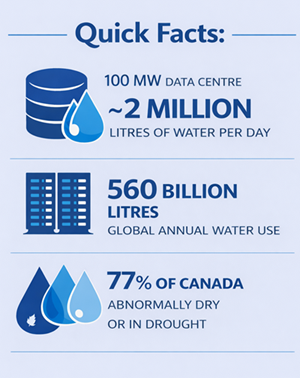
A typical 100-megawatt data centre consumes approximately two million litres of water per day, the majority sourced from municipal utilities. This water is primarily used for server cooling and is not returned to local watersheds. Global estimates suggest that data centres use more than 560 billion litres of water annually, though this figure may understate total consumption; in Texas alone, projected use for 2025 exceeds 185 billion litres. As water use escalates, the cumulative impacts—reduced groundwater recharge, strain on municipal systems, and heightened competition with residential and agricultural needs—pose growing environmental risks.
Canada’s freshwater systems are experiencing unprecedented stress. Agriculture and Agri-Food Canada reports that 77% of the country is currently classified as abnormally dry to experiencing extreme drought. British Columbia and Alberta face prolonged multi-year shortages; Alberta has reached Stage 4 of a five-stage water emergency. Quebec is preparing new water-reduction legislation, while the Atlantic provinces confront a “once-in-50-year” drought. Observations of dry wells, receding riverbeds, and algal blooms across multiple regions illustrate the combined effects of climate change, energy demand, and intensified water withdrawals.
Scale and Drivers of Data Centre Growth
AI data centre development in Canada is being driven by both federal and provincial policy objectives. The federal government has committed more than $1 billion to expanding Canada’s AI and quantum computing capacity, while the Minister of Artificial Intelligence and Digital Innovation has sought international partnerships, including agreements with Gulf states. OpenAI has approached Canada regarding potential integration into its global network of storage and compute facilities.
Provincial initiatives mirror these ambitions. Bell Canada intends to construct a six-facility data centre “supercluster” in British Columbia. Alberta has introduced an AI Data Centre Strategy targeting $100 billion in investment over five years. Microsoft has acquired multiple strategic land parcels, including sites in Quebec City and Etobicoke; the latter project has been approved to use up to 40 litres of water per second. Some proposed facilities are fossil-fuel powered and could become among the largest point sources of energy consumption in the country.
The scale of global and domestic expansion is considerable. In the United States, data centre growth accounted for an estimated 92% of GDP growth in early 2025. In Canada, investments in data centres are expected to more than double by 2030, reaching approximately $17 billion. Early evidence suggests that existing facilities are already placing substantial burdens on freshwater sources, while in the United States electricity prices in some regions have increased by as much as 267% due to rising demand from data centres.

Regional Vulnerabilities: The Great Lakes Basin
The Great Lakes region—home to approximately 847 U.S. and up to 340 Canadian data centres—is experiencing accelerating pressure. More than 100 facilities operate in the Greater Toronto Area alone. Despite this density, comprehensive data on water consumption remain unavailable. Industry stakeholders have resisted legislative efforts to mandate disclosure, hindering public-sector planning and environmental oversight. The Alliance for the Great Lakes has warned that, in the absence of strong regulation, current growth trajectories could significantly deplete regional groundwater resources. The ongoing drop in St. Lawrence River water levels underscores the vulnerability of interconnected watersheds to compounding stressors.
Governance Gaps and Indigenous Rights
Despite its expanding footprint, Canada lacks a national framework requiring data centres to report water use or to meet standardized efficiency benchmarks. Provincial oversight is inconsistent, and most operators do not disclose per-facility water withdrawals. Moreover, the implications for Indigenous rights, Title, and treaty obligations have not been adequately addressed in planning processes. This governance vacuum impedes informed environmental stewardship, undermines public trust, and constrains the ability of local and regional authorities to manage cumulative effects.
International Perspectives
Global experts have expressed mounting concern about the sustainability of current data centre expansion. Pedro Arrojo-Agudo, United Nations Special Rapporteur on the Human Right to Water, has called for a global moratorium on new data centre construction, citing risks of surpassing ecological limits and characterizing the present trajectory as a “collective suicide mission.”
Conclusion
Canada’s ambition to strengthen its AI capabilities and reduce economic dependence on foreign technologies is reshaping national infrastructure planning. However, rapid data centre expansion poses significant risks to freshwater availability, climate goals, and local ecosystems, particularly in regions already experiencing water scarcity. Without comprehensive national policies, mandatory reporting requirements, and clear protections for watersheds and Indigenous rights, Canada risks compromising its most essential natural resource. Sustainable governance of AI infrastructure is therefore a critical prerequisite for aligning technological development with long-term ecological and social stability.